Thanks for including the info on your camera, I was wondering if it was underwater or what!
I think you are saying, “Tim. If I see your gum again, it’s going in the garbage.” . . . oh, wait, that’s what I say to MY kids, lol!
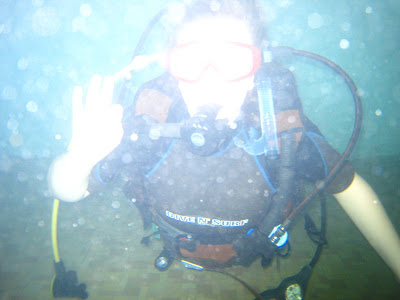
We spent the last week taking scuba lessons. These pictures are in reverse order, but I’m too tired to go back and fix them. Above, Emily is giving the “all is ok” sign during one of the skills tests.
There are certain skills tests you have to pass during each of the five confined water dives. Here are the skills you have to demonstrate proficiency in during the 1st confined water dive before you can move on to the 2nd:
1. Don and adjust mask, fins, snorkel, BCD, scuba and weights with the assistance of a buddy, instructor or certified assistant. This is NOT as easy as it sounds (LOL) since it has to be done in the water. You lay your gear out in front of you with the bottom of the tank/vest nearest you. Then, you reach over and across it to put your right arm in the arm hole. Then you sit on the tank, sliding it underneath you and twisting it around to the right direction all at the same time. After it’s facing the right way then you slip it on. So, we passed on that skill in the pool water but doing that in the ocean with waves will be another story, I’m sure. Sort of like riding a bucking brono, I think….
2. Inflate/deflate a BCD at the surface using the low pressure inflator. It took a few wrong button pushes before I got it fixed in my brain which one was to inflate and which one was to deflate.
3. In water shallow enough to stand in, demonstrate proper compressed-air breathing habits, remembering to breathe naturally and not hold the breath. This was not difficult, but it sure did seem odd to be breathing underwater. Doing this in water shallow enough to stand up in was fine since I knew I could always put my head up if I needed/wanted to.
4. Clear a regulator while underwater by exhalation and purge-button methods, and resume breathing from it. I’m glad we got to practice each of these skills several times. Each time it became easier and easier to purge the little bit of water that might have gotten in your mouth.
5. In water shallow enough to stand in, recover a regulator hose from behind the shoulder while underwater. This is not hard, but it is ackward because you can’t really see what you’re doing. You just have to feel for where they’re supposed to be and do a sweeping motion behind you or reach behind from near your shoulder area to where the hoses are supposed to be.
6. In water shallow enough to stand in, clear a partially flooded mask while under water. For some reason this one didn’t bother me.
7. Swim underwater with scuba equipment while maintaining control of both direction and depth, properly equalizing the ears and mask to accommodate depth changes. Now, you can see it’s getting a bit trickier…. more than one thing to remember to do this time (LOL). I completely forgot to try moving my jaw to equalize my ears. I think I may want to practice that one again before we go. I would NOT want to slow everyone down in Cozumel because I couldn’t equalize my ears!
8. While underwater, locate and read the submersible pressure gauge and signal whether the air supply is adequate or low based on the gauge’s caution zone.
Reading the gauge is something that isn’t hard to do, but with all of the other things to remember to do I can’t say that I actually remembered to look at my gauges very often. I’m sure as the other things become a habit I’ll have more time for my brain to remember to look at it.
9. In water shallow enough to stand in, breathe underwater for at least 30 seconds from an alternate air source supplied by another diver. This was mind over matter for me. It’s a little difficult to give up your air and start to breath from another air source, however, in a real life out of air situation I’m sure I’d be much quicker at taking the alternate.
10. While underwater, recognize and/or demonstrate standard hand signals. Easy enough if all you want to say is something that has a predetermined hand signal (LOL)…. Emily pointed out that at least we know some sign language – lol – wouldn’t do much good though unless the person you were trying to communicate with ALSO knew sign language >VBG>! In real dive situations some of people use slates of some sort.
11. Demonstrate the techniques for a proper ascent. Again. Pretty easy, but then we were in a pool that wasn’t very deep. I’m sure it’ll be different in the open water when you actually have to look at your gauge and make sure you don’t come up too quickly.
Below Tim and our friend, Mike are hanging out at the bottom of the pool. This is the first time we tried the underwater bag for my camera and it looks like we’ll have to figure out how to take better pictures. There must be some sort of trick. I’m going to ahead and load them since these are all that I have. Tim said it was REALLY hard to be underwater with Mike and not laugh because the two of them are always laughing and joking about something.
 SKILLS FOR CONFINED WATER DIVE #2
1. Perform the predive safety check. Practicing what was learned the day before.
2. Demonstrate appropriate deep-water entry(s). Same thing.
3. Clear a snorkel of water by using the blast method and resume breathing through it without lifting the face from the water. Easy enough since we learned how to do this a few years ago when we were snorkeling.
4. Exchange snorkel for regulator and regulator for snorkel repeatedly while at the surface without lifting the face from the water. The “without lifting face from the water” portion was a bit more difficult (LOL). I didn’t get it the first time around so I practiced it while waiting for the guys to do some of the things that have to be done one on one and I finally managed to do it the required number of times THANKS TO EMILY helping me.
5. Swim a distance of at least 50 metres/yards at the surface, while wearing
scuba and breathing through the snorkel. This wasn’t so difficult, but I got a little behind everyone else since there was a problem with my weight belt configuration. I got a bit flustered and actually wanted to quit at that point because I didn’t want to slow everyone else down; I was feeling rushed; and definitely didn’t feel relaxed by that time. But, I didn’t quit and eventually caught back up to the rest of the group.
6. Demonstrate a descent using the appropriate five step method. Adding to the problems of #5 was that I couldn’t get my ears to equalize so that slowed me down even more….
7. Completely remove, replace and clear the mask of water while underwater. This would be much easier if you didn’t have so much long hair floating around that you have to sweep back and try to keep out of your mask while trying to reseal it.
8. Breathe underwater for not less than one minute while not wearing a mask. For some reason I didn’t have any trouble with this. It sounds like it would be scary, but it really wasn’t.
9. Demonstrate the response to a leaking low pressure inflator by disconnecting the low pressure hose from the inflator mechanism. Another task which isn’t so difficult, but being underwater and trying to see what you’re doing is what made it difficult. Maybe if I had worn my contacts it wouldn’t have been so hard.
10. At the surface in water too deep to stand in, orally inflate a BCD to at least 1/2 full and then fully deflate it. For those that don’t know. The BCD is the vest you wear that you would normally inflate with the air from your tank. There are two buttons. One to inflate and another to deflate. If you are out of air you’ll need to be able to orally inflate your BCD at the surface so you can stay afloat. You have to push the deflate button while breathing into the hole to fill the BCD. I have a hard enough time blowing up balloons so you can imagine what this was like. I had difficulty getting the timing of when to push the button when starting to breath into the hole. I’m sure I let out 1/2 of the air I put in with the previous breath each time (LOL)…. much the same as what happens to me when I try to blow up a balloon or air mattress.
11. Adjust for proper weighting, which is defined as floating at eye level at the surface with an empty BCD and holding a normal breath. A couple pushs of a button to inflate/deflate a little… pretty easy when you have air in your tank (LOL) and don’t push the deflate button too much.
12. React to air depletion by giving the out-of air signal in water too deep to stand up in. I think this is the one where the instructor came around and turned off our air at a time when we didn’t know exactly when it was. It gave us the sensation of what it would feel like to have a tank run low and then out of air. It gets harder to take a breath.
13. Demonstrate an ascent using the appropriate five step method. Not too hard, but again, we were in a pool not the ocean where you’d really have to watch the gauges. I’m sure we’ll have more of this skill when we do our check out dives in the open water.
14. Remove weights at the surface with minimal assistance using the weight system’s quick release mechanism. Taking them “off” was the easy part. Trying to put them back in while in the water and not able to see was another thing.
15. In water too deep to stand up in, remove the weights, scuba unit and fins (if necessary), then exit using the most appropriate means. (Buddy assistance may be provided.) Again, this was pretty easy when compared to putting everything ON in the water.
This is a picture of our new found scuba friend Jen. This whole adventure started when I made a comment to someone at church that we’d like to get scuba certifiied. He said one of the gals on our worship team knew someone who was certified. So, I contacted her and she put me in touch with her friend and that’s how we met Jen. She was right there with us helping the instructor during all of our confined water skills. We had so much fun getting to know her and hope to stay in touch! THANKS JEN!
Here’s what you’ll be able to do when you successfully complete Confined Water Dive
Three: 1. Independently establish neutral buoyancy under water by pivoting on the fin tips, or, when appropriate, another point of contact (both oral and low-pressure inflation). It was so weird to see how breathing in/out deeply caused you to rise and fall. This all ties in PERFECTLY with Emily’s general science this year! We couldn’t ask for a better hands on demonstration!
2. Swim at least 10 metres/yards underwater while maintaining neutral buoyancy. After you get the hang of it, this is pretty easy. The hard part for me was figuring out how much air to let out at a time. One time I let out too much air and went right to the bottom… wouldn’t want to do that in a bottomless body of water!!3. Demonstrate the cramp removal technique. 4. At the surface in water too deep to stand in, perform a tired diver tow for 25 metres/yards. We each had to tow our partner the length of the pool. It really wasn’t a race, but I think some of us treated it like one.
5. React to air depletion by signaling out of air, then securing and breathing from an alternate air source supplied by a buddy for at least one minute while swimming underwater. I was pretty slow to give up the air I had so the instructor said he almost had to turn my air off! I’m quite certain if it were a real emergency I would have remembered to hang on to my buddy’s BCD and take the air he offered me!6. Breathe effectively from a free-flowing regulator for not less than 30 seconds.This one wasn’t difficult, but it did seem odd that you could breath with the air free flowing and the regulator 1/2 way out of your mouth without water coming in.
7. Simulate a controlled emergency swimming ascent by swimming horizontally underwater for at least 9 metres/30 feet while continuously exhaling…. I wasn’t sure I would have enough air to do this, but I made it. You really had to kick with your fins!! Speaking of which…. here they are….
More skills from the confined water test #5:
*Swim underwater without a mask for a distance of not less than 15metres/50 feet, and replace and clear the mask underwater. During this skill we had to swim with our eyes closed staying along the bottom of the pool and feeling the groove in the bottom until the instructor tapped you to say you had gone far enough and then you had to put your mask back on and clear it. Since we have practiced that several times already it wasn’t too bad… except for all of my long hair getting in the way.
5. Using buoyancy control only, hover without kicking or sculling for at
least 30 seconds.
6. Buddy breathe sharing a single air source for a distance of at least 15 metres/50 feet underwater both as a donor and a receiver. Again.. some of us have “issues” with giving up our air (LOL)!
Here is Em practicing her buoyancy control:

And, here I am. I haven’t a clue what I was doing, but it appears I was giving a hand signal of some sort.  This is the last set of skills for the confined water portion:
1. Remove, replace, adjust and secure the scuba unit and weights at the surface, with minimal assistance, in water too deep to stand up in.
2. Remove, replace, adjust and secure the scuba unit on the bottom, with minimal assistance, in water too deep to stand up in. This one was really difficult for me since the weights were IN my BCD….
3. Remove, replace, adjust and secure weight belt on the bottom in water too deep to stand in, or for students using weight integrated BCDs or weight harness systems, in shallow water, remove weights while underwater. The main thing we needed to practice is that when you take your weight belt off you want to remember to put it clear out in front of you to drop it so that it wouldn’t accidentally get tangled up in any of your gear and keep you under.Here we are at the pool edge getting our gear on for the first time. Here are Tim and Em…
 Jen, our new found scuba friend that goes to our church, is on the left… then Em, Tim, Mike, and my brother Troy. Troy wants to go on and become certified for rescue diving. As for the rest of us, I’m sure Mike has some sort of interest in underwater photography and I think it would be cool to do a night time dive which our instructor said we might be able to do that this summer when we go for our last 2 open water dives. Tim is enjoying this so hopefully that means we’ll be able to plan some more dive vacations after this! You know I’m ALWAYS up for planning a vacation!
 Here we’re in the lobby trying to figure out who wears what…
 Randy, our instructor, is unpacking and passing out all of the gear.


 These pictures were taken during the classroom portion of our test. At this point, there were 6 of us… above you might have noticed there were only 5. Amanda decided to exercise “extreme caution” and has decided to snorkel instead of scuba. She has issues with “breathing.” She passed the quizzes without a problem and I’m sure she would have done just fine on the test. We didn’t want to push her to do something she wasn’t comfortable with… so she didn’t go to the pool portion.
  Troy and another man who joined us for the classroom portion.
 She doesn’t look a bit worried here, does she?
 Thinking hard….
 Thinking harder….
 Randy is trying to get us to understand the formula for figuring out how long you can stay under at what depth….. Some of us are just a bit slower than others, but I won’t mention any names.
 Em……thinking….
 Mike giving us his interpretation of air density at x feet.
 Tim and the other man going over their calculations.
 open book knowledge reviews….
 who knows what I might have been saying…..
 Randy explaining the calculations over and over and over! He was VERY patient with us.
 Amanda and Emily working hard on their quizzes. Emily also wanted to quit, but we wouldn’t let her. She argued that it wasn’t fair that we let Amanda quit, but not her… but her reasons were different and not valid in our opinions. She was worried about her ability to take the tests. After all was said and done she got a higher score than me by one question! WAY TO GO EM!
 Em and I studying the manual at home… pretty much all we did for the 4 days leading up to the classroom portion of the class. Here we are practicing equalizing.
 Em was tired of listening to me read and I was tired of reading out loud. We did take turns some of the time.
 Emily did an Adventure Scuba class two years ago with her synchro team and has been interested in taking another class ever since then. Two years ago when we were snorkeling in the Caymen Islands we decided if we ever had the opportunity to go to the Caribbean again we would consider doing scuba. Well.. we are going again in a few weeks, but I’m pretty certain we would not have persued scuba if Mike hadn’t wanted to do it. Emily sort of wanted to, but was worried about the tests and I may not have persued it. Anyway. Thanks to Mike being the catalyst, the timing all working out right, etc., and here we are! I already mentioned Jen above She put us in touch with our instructor, Randy. He was an awesome instructor and we’re all feeling pretty good about our ability to continue on. We will do 2 of our open water dives in Cozumel at the end of the month and then next summer we will finish our last 2 open water dives back here with Randy.
Thanks for including the info on your camera, I was wondering if it was underwater or what!
I think you are saying, “Tim. If I see your gum again, it’s going in the garbage.” . . . oh, wait, that’s what I say to MY kids, lol!
You’re welcome, Kristine. I should take a picture of the camera bag and post it. It’s only good to 15 feet which I thought was a LONG WAYS *before* we took the class. Now I realize that 15 feet barely gets you anywhere (LOL) and our 2nd dive will be up to 60 feet. Cameras or bags rated to that distance are quite expensive so I don’t think we’ll be getting any pictures from down that far!
You are brave! I’m with Amanada.
Jamie did a basic two day diving course in Florida when we were away on holiday onec, but it didn’t appeal to me one bit!
Dorothy
The photo of Tim with the gum made me wonder if it should be labelled “Thinking…. Thinking harder….. and hardly thinking!” LOL! That series of photos is very cute! What fun!
Oh… GOOD ONE, Lee! Why didn’t I think of that (LOL).
What wonderful pictures–such a complete photo guide of the whole process. It’s really a fascinating process – I never realized how much goes into a certification. And I definitely never thought about the math aspect of it all. Way to go!!
You all are so brave. I have snorkled but I don’t think I have the courage enough for scuba lessons.
Kathy,
It really wasn’t that there was so much math. It’s just that I found the tables confusing. I’m SURE if I sat down with them in the quiet and comforto of my own home I could read the manual and figure it out. For now it was just a blur of steps and I’m the type person who needs to know “why” before it clicks…and so far just going from one column to the other and back didn’t tell me why so it’s just not sticking in my head. I will review it again before we go though and see if I can get it! I got it enough to pass, but hey.. I want to be able to LIVE to tell about the dive so I’m highly motivated to “get it”.
In a differn spot Kathy asked me if I typed all of those things from memory. GOODNESS NO! My memory isn’t *that* good (LOL). I cut/paste from the manual which we have on CD.